
Become an Ocean Hero: Learning Conservation Through Play


October 3, 2026 – Pasay City, NCR, Philippines
Article by Nicole Fajilagot
How can museums inspire people to care for the ocean? At AIMS Museo Maritimo, one answer comes through the Mobile Maritime Museum, an outreach initiative that combines maritime heritage, ocean literacy, and interactive learning. Designed for students and communities, the exhibit brings ocean conservation education directly to the public through fun and engaging educational games.
Research has shown that interactive and game-based museum activities can improve visitor engagement, motivation, and learning outcomes (Jingwen et al., 2024). Likewise, museums are increasingly using playful and participatory approaches to make complex social and environmental issues more accessible to diverse audiences (Olesen & Holdgaard, 2024).
Phase 1: Awareness and Emotional Connection
Salba-Buhay: Throw the Lifebuoy

The journey begins with Salba-Buhay: Throw the Lifebuoy, a ring-toss game that introduces participants to endangered marine animals found in Philippine waters. Through the symbolic act of rescuing marine species, visitors are encouraged to develop empathy and a stronger emotional connection with the ocean. Studies suggest that interactive museum experiences can increase environmental awareness and encourage deeper engagement with conservation issues by connecting knowledge with personal experiences (Sun et al., 2025). By learning about threats such as plastic pollution, habitat destruction, and climate change, participants begin to understand why marine biodiversity protection matters.
Phase 2: Knowledge Building and Ocean Literacy
Ocean Hero Spinner Challenge

After developing awareness, participants move to the Hero Spinner Challenge, which strengthens ocean literacy through active recall and participation. Players answer questions about sea animals, maritime jobs, sea plants, boats, and other concepts related to the maritime world. According to UNESCO (2024), ocean literacy refers to understanding the ocean’s influence on people and people’s influence on the ocean. Educational activities that promote ocean literacy help individuals make informed decisions and encourage responsible behavior toward marine resources. Through active participation, visitors gain a broader understanding of how the ocean contributes to Philippine culture, history, livelihood, and national identity.
Phase 3: Stewardship and Civic Responsibility
ChronoSea: A Maritime Law Timeline Game

The final stage of the exhibit introduces participants to maritime laws and environmental governance through ChronoSea: A Maritime Law Timeline Game. By arranging maritime laws and historical events in chronological order, players learn how legal frameworks contribute to the protection and sustainable management of marine resources. Ocean conservation depends not only on scientific knowledge but also on public participation and informed decision-making. Understanding maritime governance helps visitors recognize that protecting the ocean is a shared responsibility involving governments, communities, and individual citizens.
From Awareness to Action
Together, the three games demonstrate how maritime heritage can be transformed into a meaningful educational experience that progresses from awareness to understanding and eventually to stewardship. Research on gamification shows that game-based learning can improve motivation, knowledge retention, and long-term engagement with educational content (Jaramillo-Mediavilla et al., 2024). Through this approach, the Mobile Maritime Museum encourages participants to become active stewards of the ocean while strengthening their appreciation of the Philippines as a maritime nation.
As an archipelagic country whose history, culture, and economy are closely tied to the sea, the Philippines benefits from educational initiatives that connect maritime heritage with environmental responsibility. The Mobile Maritime Museum demonstrates that museums can be powerful spaces for both learning and action, helping inspire a new generation of Ocean Heroes committed to protecting the country's marine heritage for future generations.
Make Your #MyOceanPledge
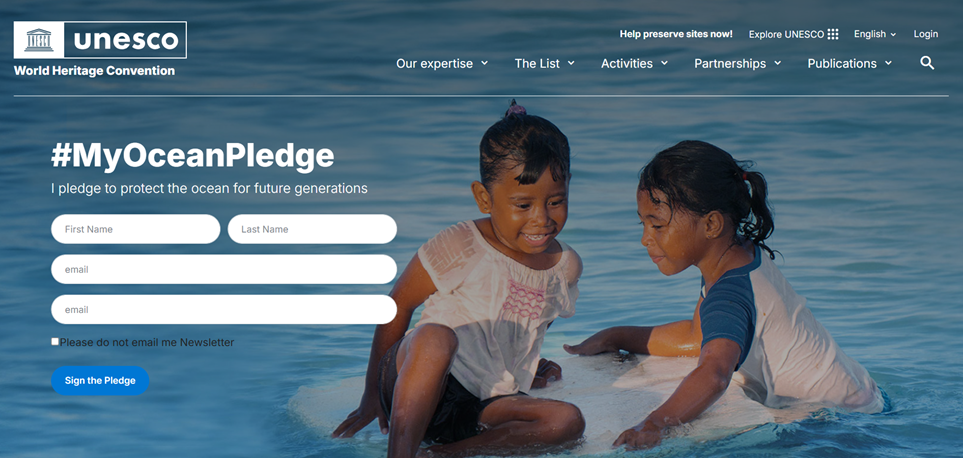
After completing the three educational games, participants are invited to take the next step from learning to action by making their own #MyOceanPledge. Through this activity, visitors write or share a personal commitment describing how they will help protect the ocean in their daily lives. This may include reducing plastic waste, supporting coastal clean-up activities, conserving marine resources, or promoting ocean awareness within their communities.
Inspired by UNESCO’s global #MyOceanPledge campaign, the activity encourages participants to recognize that ocean conservation begins with individual responsibility and collective action. The campaign was originally launched by young people from UNESCO World Heritage Marine Programme who called on people around the world to pledge their commitment to protecting the ocean for future generations.
As the final component of the Mobile Maritime Museum experience, the pledge transforms awareness, knowledge, and stewardship into a personal commitment. By signing their pledge, participants are reminded that protecting the ocean is not only a lesson learned inside the exhibit but also a responsibility that continues beyond the museum. In this way, the exhibit journey progresses from awareness and emotional connection, to ocean literacy, to stewardship and civic responsibility, and ultimately to real-world action. This approach reflects UNESCO’s broader vision of ocean literacy, which seeks to transform ocean knowledge into responsible action for a more sustainable future.
References
Jaramillo-Mediavilla, L., Basantes-Andrade, A., Cabezas-González, M., & Casillas-Martín, S. (2024). Impact of Gamification on Motivation and Academic Performance: A Systematic Review. Education Sciences, 14(6), 639. https://doi.org/10.3390/educsci14060639
Olesen, A. R., & Holdgaard, N. (2025). Why Play in Museums? A Review of the Outcomes of Playful Museum Initiatives. Journal of Museum Education, 50(4), 502–513. https://doi.org/10.1080/10598650.2023.2297323
Sun, X., Lee, K. E., & Lim, C. K. (2025). The integration of sustainable development elements into interaction design for ocean conservation education in the natural history museum: A review. Sustainable Futures, 10, 101260. https://doi.org/10.1016/j.sftr.2025.101260
UNESCO. (2024). Ocean literacy for all. https://www.unesco.org/en/articles/ocean-literacy-all-0
Zhang, J., Zhu, T., & Chang, X. (2026). Educational Games of Museums: A Literature Review. Games and Culture, 21(3), 553-587. https://doi.org/10.1177/15554120241270058


Comments