
A Decade of Conversations: The Philippine Maritime Heritage Forum at Ten


October 23, 2026 – Pasay City, NCR, Philippines
Article by AIMS Museo Maritimo Team
Every year, the Philippines looks to the sea in different ways. For some, it is a source of livelihood; for others, a passage for trade and travel, a home to diverse marine life, or a connection to generations of history and culture. For AIMS Museo Maritimo, the sea has also been the starting point of a conversation — one that began in 2015 and continues to evolve a decade later.
The Philippine Maritime Heritage Forum began through the efforts of Mr. Jasper Christian L. Gambito, then Museum Curator, and Dr. Ronel M. Gillesania, then Executive Director of AIMS. Established as part of the museum's commitment to becoming a home for maritime knowledge exchange, the forum sought to bring together people who could help tell the story of the Philippines as a maritime nation.
The early conversations looked to the past. The first three forums explored the country's historical connections with the sea, the cultural exchanges that shaped Filipino identity, and the development of the Philippine maritime industry. These discussions established an important starting point: understanding the Philippines requires understanding how the sea has shaped its people, communities, and history.
As the forum continued, the questions changed. The fourth, fifth, and sixth editions turned toward the Philippines' place in a global maritime landscape, examining globalization, maritime movements, and contemporary maritime issues. The conversation was no longer limited to tracing what had happened; it also considered the country's position in the maritime world and the opportunities and challenges that lay ahead.
In 2022, the seventh forum, “Curating a National Maritime Narrative: AIMS Museo Maritimo Turns Ten,” brought the discussion back to the museum itself. As AIMS Museo Maritimo marked its first decade, the forum reflected on the institution's work in documenting, interpreting, and sharing maritime heritage. It was also a reminder that a national maritime narrative is not something a museum can build alone. It grows through research, shared experiences, and the participation of people whose lives are connected to the sea.
The succeeding forums brought these conversations closer to contemporary practice. The eighth explored how maritime history could contribute to innovation and development in the maritime industry. The ninth, “Our Seas, Our Story: From Heritage to Sovereignty,” examined the relationship between maritime activities and marine life, drawing attention to the need to consider the ocean's ecosystems alongside the industries and communities that depend on them.
Across these editions, the forum's focus gradually widened. What began as an effort to retrace the country's maritime past became an opportunity to ask how that past might inform the present. The sea is not simply a setting for historical events or an economic resource. It is an interconnected environment in which human activity, cultural traditions, livelihoods, and marine life continually influence one another.
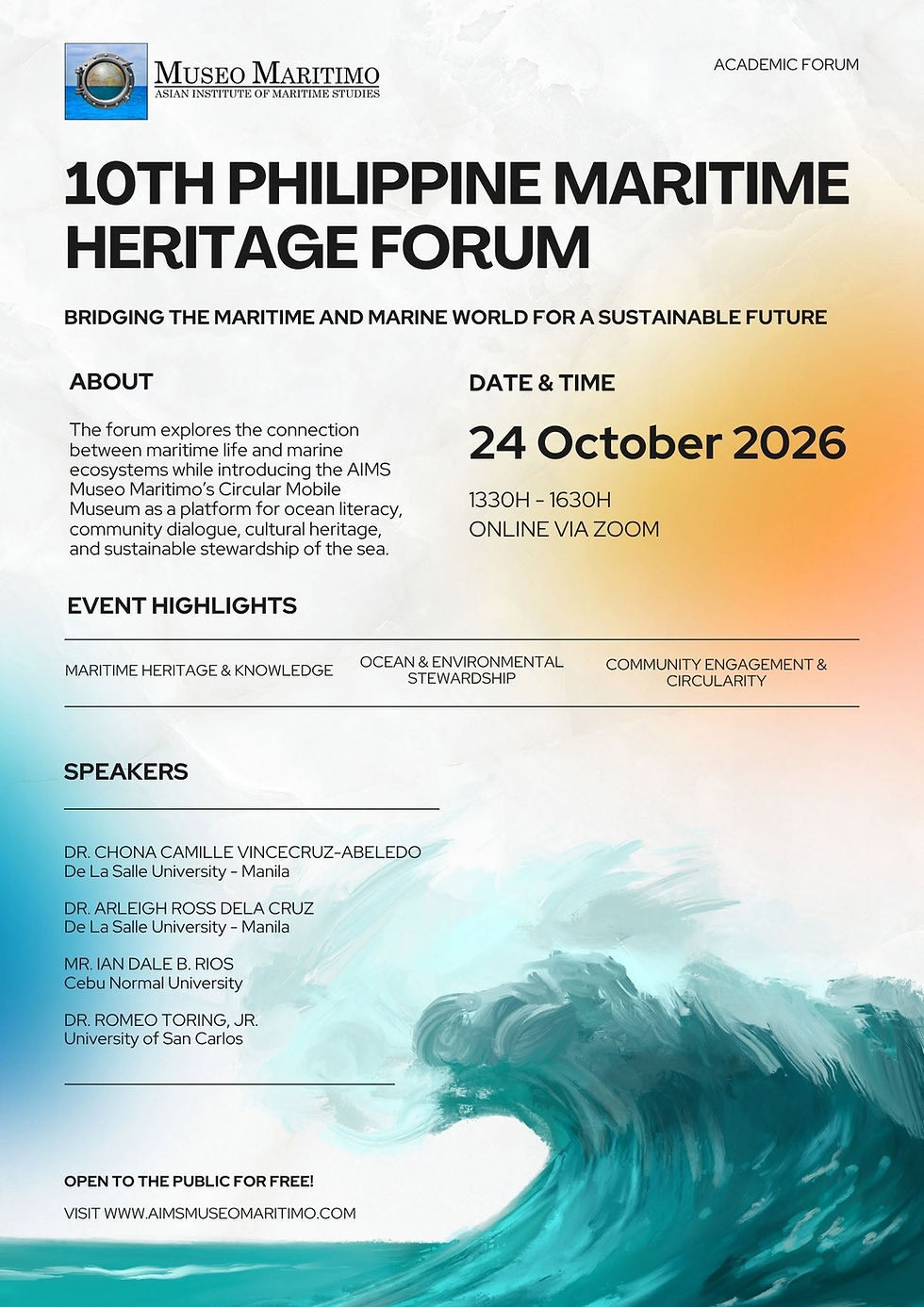
This understanding guides the 10th Philippine Maritime Heritage Forum, titled “Bridging the Maritime and Marine World for a Sustainable Future,” to be held online through Zoom on October 24, 2026. 📅 24 October 2026 (Saturday)
⏰ 1:30 PM–4:30 PM
💻 Online via Zoom
🎟️ FREE admission | Certificate provided
Meeting ID: 842 7733 6042 | Passcode: 055825
The tenth edition brings together perspectives from science, history, policy, cultural heritage, and traditional knowledge. Its central concern is familiar yet increasingly urgent: how can people continue to benefit from the sea while caring for the marine environment that sustains them? Answering this requires more than a single discipline. Historical accounts can reveal how relationships with the sea have changed; scientific knowledge can help explain the condition of marine ecosystems; and community experiences can show how these changes affect everyday life.
But conversations become more meaningful when they travel beyond the conference itself.
This is where AIMS Museo Maritimo's planned Circular Mobile Museum enters the story. Planned to be housed in an Owner-Type Jeep assembled largely from reused and recycled components, the project aims to bring maritime and ocean literacy closer to communities. Its design also reflects a simple principle: materials that already exist can be valued, repurposed, and given new life.
The mobile museum extends the forum's purpose beyond the exchange of ideas among speakers and participants. It creates an opportunity to bring maritime stories and knowledge to places where people live, work, and learn. Just as importantly, it opens the possibility for communities to contribute their own stories, experiences, and perspectives to the museum's work.
The insights gathered through the tenth forum will help shape the mobile museum's content, connecting research and expert knowledge with the experiences of people whose lives are tied to the sea. In this way, the forum and the mobile museum become part of the same effort: making maritime heritage accessible, relevant, and open to participation.
Ten years after the first forum, AIMS Museo Maritimo continues to ask questions about the Philippines and its relationship with the sea. The subjects have expanded from historical connections and national identity to industry, marine life, sustainability, and community engagement. Yet the purpose remains consistent: to create a space where knowledge can be shared and new perspectives can emerge.
A decade of conversations is not a conclusion. It is a record of how understanding develops when people continue to ask questions, revisit familiar stories, and consider different points of view. As the Philippine Maritime Heritage Forum enters its tenth edition, the challenge is to carry these conversations forward — not only through another gathering, but through the knowledge, stories, and actions that follow.
The sea has always connected the Philippines to the wider world. Through a decade of conversations, AIMS Museo Maritimo continues to explore what those connections mean, and how understanding them can help shape a more sustainable future.


Comments