
10th Philippine Maritime Heritage Forum Bridges Maritime Heritage and Marine Conservation


October 27, 2026 – Pasay City, NCR, Philippines
Article by AIMS Museo Maritimo Team
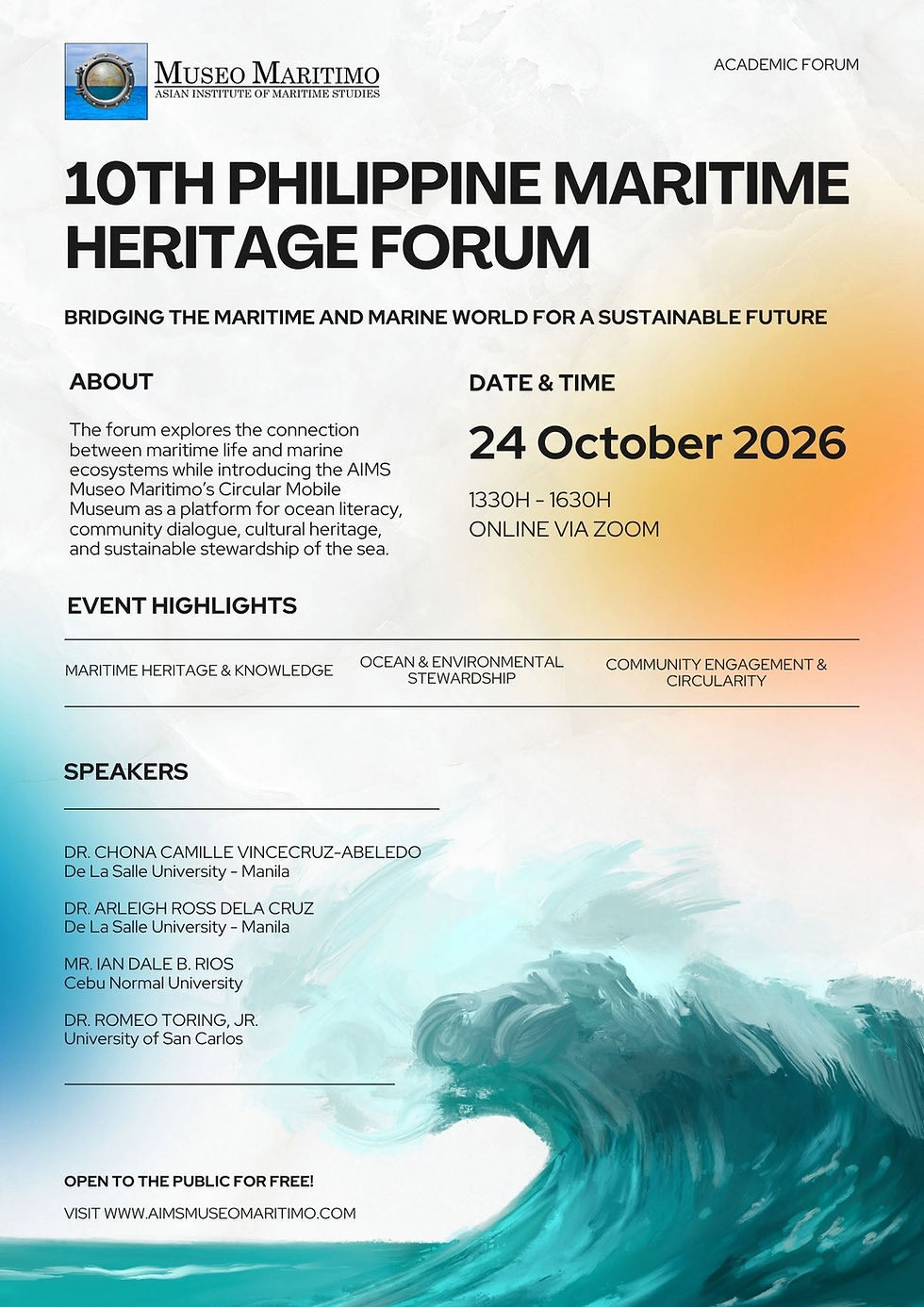
AIMS Museo Maritimo successfully concluded the 10th Philippine Maritime Heritage Forum on October 24, 2026, held virtually via Zoom, bringing together perspectives from marine science, history, cultural heritage, traditional knowledge, and maritime studies under the theme “Bridging the Maritime and Marine World for a Sustainable Future.” It was attended by participants within and outside the AIMS Community.
Coinciding with Museums and Galleries Month and the 14th anniversary of AIMS Museo Maritimo, the event emphasized that understanding the country's maritime past can provide valuable insights into how communities can build a more sustainable relationship with the ocean.
The forum opened with remarks from Daryl Lorence Abarca, Museum Curator & Researcher of AIMS Museo Maritimo, who posed a thought-provoking question to frame the discussions: “How can understanding our maritime past shape a more sustainable relationship with the sea?”
In his opening remarks, Abarca highlighted the museum's continuing efforts to promote maritime and ocean literacy through programs and public engagement activities. Among these initiatives was the premiere screening of Ocean with David Attenborough, which encouraged audiences to reflect on the importance of marine ecosystems and the need to protect them.

He also introduced the museum's developing Circular Mobile Museum Project, presenting a visual rendering of the proposed mobile maritime museum. Designed to bring maritime history, ocean knowledge, and conservation closer to communities, the project reflects the museum's commitment to making maritime heritage more accessible beyond the traditional museum space.
The first presentation was delivered by Dr. Chona Abeledo, who discussed “Bridging Science and the Sea.” Her presentation underscored that marine conservation is not solely a scientific concern. It requires collaboration, knowledge-sharing, and meaningful community participation.
The second presentation, “Between Port and Pasture: Cattle Importation, Quarantine, and Regulations on Livestock Movement in the Colonial Philippines, 1902–1934,” was delivered by Dr. Arleigh Ross Dela Cruz. Dr. Dela Cruz examined the movement of livestock across Philippine ports during the American Colonial Period. He discussed cattle importation policies, quarantine measures, and regulations governing livestock movement, as well as how these policies affected importers and cattle raisers. It also offered a broader understanding of how ports functioned not only as gateways for people and commodities, but also as important points of control and exchange in the country's economic history.
The third presentation was delivered by Asst. Prof. Ian Dale Rios, who explored native seacrafts and ethnoastronomy in his presentation entitled "Maritime Spaces as Vital Local Cultural Heritage Sites in the Philippines". His discussion highlighted the ingenuity of communities in Camotes Islands and the knowledge systems that enabled them to navigate and live with the sea. Native seacrafts represent more than modes of transportation; they embody generations of knowledge about materials, construction, waterways, weather, navigation, and the natural environment.
The forum's final presentation was delivered by Dr. Romeo Toring Jr., who discussed Cebu's Maritime History and Traditions from the precolonial period to the present in his presentation "Pagpanday sa Baroto ug Paglayag sa Barko: Changing Maritime Traditions of the Philippines from Cebu, the Visayas and beyond". His presentation traced the development and continuity of Cebu's maritime traditions across different historical periods. From its precolonial connections and maritime communities to the transformations brought by colonialism and the continuing importance of the sea today, the discussion illustrated how maritime activities have shaped Cebu's identity, economy, culture, and communities.
The forum concluded with closing remarks from CLAMS Dean Mr. Juan Martin Guasch, who reflected on the library and museum's activities throughout the years. His remarks provided an opportunity to look back at the institution's continuing efforts to preserve, document, interpret, and share knowledge about the country's maritime heritage.
The discussions throughout the forum demonstrated that maritime heritage extends far beyond ships and ports. It encompasses ecosystems, communities, traditional knowledge, scientific discoveries, trade, migration, policies, livelihoods, and cultural traditions.

As the 10th Philippine Maritime Heritage Forum came to a close, it left participants with a shared reminder: the future of the sea is deeply connected to our understanding of its past. Through initiatives such as the Philippine Maritime Heritage Forum and the developing Circular Mobile Museum Project, AIMS Museo Maritimo continues to create spaces for dialogue, learning, and appreciation of the Philippines' enduring relationship with the sea—helping ensure that maritime heritage remains a source of knowledge and inspiration for a more sustainable future.


Comments