
Part 2: Terms of Engagement — An Everyday Reader’s Guide to Philippine Ships, Tech, and Tactics
- museomaritimo

- 1 day ago
- 11 min read

August 25, 2026 – Quezon City, NCR, Philippines
Article by Whesley Samar
Defense and Maritime Security | West Philippine Sea
Field Guide: Vessels, Tech, and Terms of the PCG and PN
Understanding who guards Philippine waters comes down to knowing two key organizations. The Philippine Coast Guard (PCG) was established under Republic Act No. 9993. The Philippine Navy (PN) draws its mandate from Article II, Section 3 of the 1987 Constitution and from Executive Order No. 292. Each operates under a different department: the PCG reports to the Department of Transportation under E.O. No. 477, while the PN falls under the Department of National Defense. A useful shorthand is white hulls and gray hulls. The Coast Guard's white-hulled ships handle maritime law enforcement and first response. The Navy's gray-hulled ships handle sea-based military defense.
Philippine Coast Guard (PCG) Fleet
To carry out these frontline law enforcement and patrol duties, the PCG relies on a specialized fleet of white-hulled vessels designed for endurance, rescue, and presence operations.

Ship Class & Representative Vessel: Teresa Magbanua Class (BRP Teresa Magbanua, MRRV-9701)
Key Specs: Displacement: ~2,260 tons | Length: 97 meters
Origin & Builder: Japan (Mitsubishi Heavy Industries)
Primary Operational Duties & Features: Multi-Role Response Vessel (MRRV) serving as the PCG's largest operational platform. Equipped with a helideck, hangars, high-capacity water cannons, dynamic positioning, and uncrewed underwater vehicles (UUVs) built for sustained EEZ patrols.

Ship Class & Representative Vessel: San Juan Class (BRP EDSA II, SARV-002)
Key Specs: Displacement: ~540 tons | Length: 56 meters
Origin & Builder: Australia (Tenix Defence)
Primary Operational Duties & Features: Search and Rescue Vessel (SARV) designed for offshore disaster response, towing, search and rescue operations, and environmental protection. Features a stern launch ramp for fast rescue craft.

Ship Class & Representative Vessel: Parola Class (BRP Tubbataha, MRRV-4401)
Key Specs: Displacement: ~320 tons | Length: 44 meters
Origin & Builder: Japan (Japan Marine United)
Primary Operational Duties & Features: Patrol & Enforcement workhorse used for coastal surveillance, anti-smuggling, interdiction, and humanitarian relief across major regional sea lanes.

Ship Class & Representative Vessel: Boracay Class (BRP Boracay, FPB-2401)
Key Specs: Displacement: ~120 tons | Length: 24 meters
Origin & Builder: France (OCEA)
Primary Operational Duties & Features: Fast Patrol Boat (FPB) featuring high-speed aluminum hulls designed for rapid interdiction across shallow coastal waters, bays, and archipelagic channels.
Philippine Navy (PN) Fleet
Beyond civil maritime patrol lies external defense, where the Philippine Navy deploys its combat capabilities and armed fleet to secure national sovereignty.

Ship Class & Representative Vessel: Tarlac Class (BRP Tarlac, LD-601)
Key Specs: Displacement: ~11,583 tons (full load) | Length: 123 meters
Origin & Builder: Indonesia (PT PAL)
Primary Operational Duties & Features: Landing Dock (LD) sealift and amphibious transport ship. Serves as a floating command center and disaster relief logistics hub while housing landing craft, helicopters, and ground troops.

Ship Class & Representative Vessel: Jose Rizal Class (BRP Jose Rizal, FF-150)
Key Specs: Displacement: ~2,600 tons | Length: 107 meters
Origin & Builder: South Korea (HD Hyundai Heavy Industries)
Primary Operational Duties & Features: Multi-role surface warship frigate armed with surface-to-air missiles, anti-ship missiles, torpedoes for anti-submarine warfare (ASW), and a 76mm main gun.

Ship Class & Representative Vessel: Miguel Malvar Class (BRP Miguel Malvar, FFG-06)
Key Specs: Displacement: ~3,200 tons | Length: 118 meters
Origin & Builder: South Korea (HD Hyundai Heavy Industries)
Primary Operational Duties & Features: Guided-missile frigate optimized for anti-air, anti-surface, and anti-submarine warfare (ASW), featuring a 16-cell Vertical Launching System (VLS), C-Star anti-ship missiles, and torpedoes.

Ship Class & Representative Vessel: Conrado Yap Class (BRP Conrado Yap, PS-39)
Key Specs: Displacement: ~1,200 tons | Length: 88 meters
Origin & Builder: South Korea (Korea Tacoma)
Primary Operational Duties & Features: Corvette platform dedicated to coastal defense and anti-submarine warfare, equipped with depth charge launchers, torpedo tubes, and automatic cannons.

Ship Class & Representative Vessel: Jacinto Class (BRP Emilio Jacinto, PS-35)
Key Specs: Displacement: ~763 tons | Length: 62 meters
Origin & Builder: United Kingdom (Hall, Russell & Co.)
Primary Operational Duties & Features: Offshore Patrol Vessel (OPV), formerly British Peacock-class, used for long-range sea lanes monitoring and armed with a 76mm Oto Melara main gun.

Ship Class & Representative Vessel: Acero Class (BRP Nestor Acero, PG-901)
Key Specs: Displacement: ~95 tons | Length: 32 meters
Origin & Builder: Israel (Israel Shipyards)
Primary Operational Duties & Features: Fast Attack Interdictor Craft (FAIC) high-speed coastal patrol boat fitted with remote weapon stations and short-range non-line-of-sight (NLOS) missiles.
While capital patrol ships and surface combatants dominate public attention, dozens of specialized support platforms work out of sight to keep primary units underway. These assets form the operational spine of both services, handling fuel transfers, harbor logistics, and close-in boarding tactics. Because they lack the long-range sensor suites, heavy armament, and sustained endurance required for solo territorial defense in deep waters, they fall outside the primary combatant roster detailed above.
Auxiliary and Support Vessels


Logistics Ships and Replenishment Tankers: Ships such as the Navy’s Bacolod City-class logistics transport vessels move bulk fuel, fresh water, and heavy equipment between island bases (Nepomuceno, 2020). They carry light crew-served weapons for basic self-defense and depend on warship escorts during high-threat transits.
Tugboats and Salvage Craft: Harbor tugs, including the PCG’s TB Habagat, manage ocean towing, ship-assist maneuvers, and hazardous salvage tasks (The Maritime Review, 2022). Built for high bollard pull rather than speed, these civilian-style utility hulls operate near major ports like Manila, Subic, and Cebu.
Small Tactical Craft


Rigid-Hull Inflatable Boats (RHIBs): Stowed on the stern ramps and davits of large cutters like the Teresa Magbanua class, these high-speed composite craft carry specialized Visit, Board, Search, and Seizure (VBSS) teams across the final yards to intercept suspect vessels (Philippine Coast Guard, 2021; Parreño, 2022).
Aluminum and Composite Rescue Craft: Open-hulled utility craft deployed across local Coast Guard stations to conduct flood rescues, harbor security sweeps, and shallow-water interdictions where deep-draft vessels cannot navigate (Nepomuceno, 2023).
Key Concepts, Technology, and Terminology
Having covered the primary vessels of the PCG and PN, the following concepts and terminology explain how these platforms function operationally in the field.
White-Hull vs. Gray-Hull Operations:
A2/AD (Anti-Access/Area Denial): Strategies and weapons used to block an opponent from entering or operating in a region. Think of it as an integrated home security system with motion sensors, fences, and remote locks meant to keep trespassers out.
Assertive Transparency: A communication strategy using real-time recording and public broadcasting of maritime encounters and law enforcement blockades. Think of it as a police officer wearing a live-streaming body camera during an operation.
Dark Vessel / Dark Fleet Operations: Ships that turn off their Automatic Identification System (AIS) transponders to hide their location and illegal activity. Think of it as a car driving down a highway at night with its headlights off.
Domain Awareness (MDA - Maritime Domain Awareness): The total operational tracking of vessels, weather, and sea activity to ensure safety and security. Think of it as air traffic control, but for everything across the ocean.
Gray-Zone Operations: Coercive tactics like using maritime militias, swarming, or non-lethal force that stay just below the threshold of open war. Think of it as aggressive tailgating on a highway to intimidate without causing a crash.
Gray Hull (PN): Naval warships built for combat, defense, and deterrence. Think of them as armored military vehicles whose presence marks a combat zone governed by strict military rules of engagement.
RoRe (Rotation and Resupply) Mission: Tactical supply runs delivering fresh troops, food, fuel, and gear to remote outposts like BRP Sierra Madre at Ayungin Shoal. Think of it as an armored supply run to an isolated mountain outpost.
Shadowing: Following and monitoring a foreign or non-compliant vessel closely to track and challenge its actions. Think of it as a store associate trailing an unannounced guest through a shop to keep eyes on them.
White Hull (PCG): Civilian law enforcement and rescue ships enforcing domestic laws and de-escalating standoffs. Think of them as highway patrol cruisers using lightbars and megaphones to maintain order.
Key Maritime Terms
To fully decode these operational reports and ship specifications, a basic understanding of key maritime law and naval architecture terminology is essential.
Displacement: The weight of water a vessel displaces, equaling its total weight. Higher displacement means a heavier hull built for rough, deep-ocean swells.
Draft: The vertical distance from the waterline to the bottom of the hull. It determines how shallow the water can be before a ship grounds. Think of it as underwater clearance depth.
EEZ (Exclusive Economic Zone): A maritime area extending 200 nautical miles from a coastline where a state holds exclusive rights to explore and manage resources under UNCLOS.
Freedom of Navigation Operation (FONOP): A naval mission that asserts navigational rights recognized under international law, typically conducted in waters where a state's maritime claim exceeds what UNCLOS permits. Think of it as driving down a public road to establish that a neighbor has no legal right to block it.
Hot Pursuit: The legal right under UNCLOS allowing authorities to chase, board, and arrest a foreign vessel beyond the EEZ, provided the chase started in national waters and remained continuous. Think of it as a police chase across town lines that stays legal as long as visual contact is maintained.
Innocent Passage: International law allowing foreign ships to transit a nation's territorial sea quickly and continuously without hostile action. Think of it as walking peacefully down a sidewalk passing through a private neighborhood.
Knot: The standard nautical unit of speed, equal to one nautical mile per hour (1.85 km/h). Think of it as a ship's speedometer reading.
Nautical Mile: The standard unit of maritime distance, equal to 1,852 meters (1.15 miles). Think of it as the ocean's version of a kilometer.
UNREP (Underway Replenishment): Transferring fuel, ammunition, and supplies between ships while moving at sea. Think of it as the maritime equivalent of mid-air refueling.
VBSS (Visit, Board, Search, and Seizure): Interdiction tactics where teams board target vessels via boats or helicopters to inspect cargo, confiscate contraband, or detain suspects. Think of it as a tactical SWAT raid on a vessel.
Naval Weapons & Tactical Systems
Beyond movement and logistics, a vessel’s capability ultimately relies on its payload; ranging from non-lethal deterrents used in gray-zone encounters to heavy combat systems built for naval warfare.

Water Cannons: Non-lethal tools mounted on Coast Guard hulls that fire high-pressure seawater to push back or blind intruder vessels without firing live explosives. Photo: Marine Link
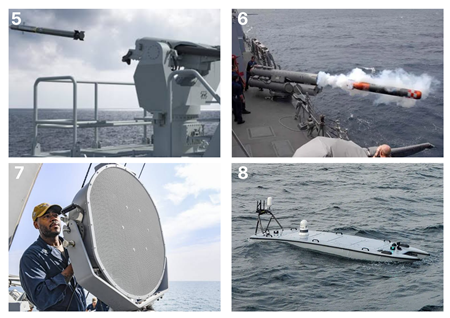
Autocannons: Rapid-fire automatic cannons (typically 25mm to 76mm) discharging explosive shells to destroy surface craft and airborne threats. They function like heavy machine guns mounted on remote weapon mounts. Photo: Wikipedia
CIWS (Close-In Weapon System): An automated, radar-guided defense system firing thousands of rounds per minute to destroy incoming Anti-Ship Missiles (ASMs). This acts as a ship-based point defense shield. Photo: Army Recognition
Surface-to-Surface Missiles (SSMs): Sea-skimming guided missiles designed to strike hostile surface ships beyond the visual horizon. Think of them as long-range precision strikes for naval combat. Photo: Defence Express
Surface-to-Air Missiles (SAMs): Guided interceptors launched from vertical launch systems (VLS) or deck mounts to destroy incoming jets, drones, or anti-ship missiles. Photo: PNA
Torpedoes & Anti-Submarine Warfare (ASW): Self-propelled acoustic weapons launched from surface tubes or dropped by helicopters to track and destroy submerged submarines. Photo: Britannica
LRAD (Long Range Acoustic Device): Directed acoustic arrays that project voice instructions or emit high-decibel warning tones across long distances. This functions as a directional sound spotlight. Photo: Solas Marine
UUVs/USVs (Uncrewed Underwater/Surface Vehicles): Remote or autonomous drones deployed for subsea mapping, mine countermeasure operations, and hydrographic surveys. Photo: Naval News
Applied Operations: A Hypothetical Scenario
To see how these assets, legal terms, and tactical systems come together on the frontlines, consider a typical hypothetical incident unfolding in the West Philippine Sea. At 0400 hours, radar operators detect an unidentified foreign fishing fleet, escorted by a foreign coast guard cutter, entering the Philippine EEZ near Sabina Shoal to harvest giant clams.
The Coast Guard dispatches BRP Teresa Magbanua (MRRV-9701) to intercept the cluster. Station commander Commander Antonio Dela Cruz broadcasts radio warnings, launches RHIBs to execute a VBSS inspection, fires LRAD acoustic beams to issue verbal advisories, and directs high-pressure water cannons to repel intruding hulls. Nearby, a smaller PCG patrol craft executes a concurrent RoRe run, delivering fresh food and medical kits to a nearby maritime station. Standing off 30 nautical miles beyond the horizon, the Navy frigate BRP Jose Rizal (FF-150) tracks every target on radar, keeping its SAMs, SSMs, and CIWS online. The Navy maintains overwatch to prevent military escalation, ready to engage if foreign warships break the threshold of open hostility.
As the West Philippine Sea standoff deepens, Coast Guard and Navy crews walk a high-stakes tightrope. Under UNCLOS, they must defend national sovereignty with absolute strategic restraint, holding the line without triggering all-out war. In our next installment, step onto the frontline. We break down the PCG’s operational playbook, assertive transparency strategy, and raw supply runs where dynamic positioning, live streaming, and calculated tactical maneuvers face off against aggressive high-seas interception.
Bibliography
Caterpillar Marine. (2010). Philippine Coast Guard SAR. Internet Archive. https://web.archive.org/web/20140315102954/http://marine.cat.com/cda/files/2506262/7/Philippine%20Coast%20Guard%20SAR.pdf
Constitutional Commission of 1986. (1987). The 1987 Constitution of the Republic of the Philippines. Official Gazette of the Republic of the Philippines. https://www.officialgazette.gov.ph/constitutions/1987-constitution/
Department of the Navy. (2017). Underway replenishment doctrine (NWP 4-01.4). Navy Warfare Development Command. https://www.nwdc.navy.mil/
Department of the Navy. (2020). Maritime interception operations (NTTP 3-07.11). Navy Warfare Development Command. https://www.navy.mil/
Encyclopedia Britannica. (2024a, February 16). Surface-to-surface system. https://www.britannica.com/technology/surface-to-surface-system
Encyclopedia Britannica. (2024b, May 24). Surface-to-air missile. https://www.britannica.com/technology/surface-to-air-missile
Encyclopedia Britannica. (2024c, May 24).
Fourteenth Congress of the Republic of the Philippines. (2010). Republic Act No. 9993: An act establishing the Philippine Coast Guard as an armed and uniformed service attached to the Department of Transportation and Communications, thereby repealing Republic Act No. 5173, as amended, and for other purposes. Official Gazette of the Republic of the Philippines. https://www.officialgazette.gov.ph/2010/02/12/republic-act-no-9993/
Friedman, N. (2006). The Naval Institute guide to world naval weapon systems (5th ed.). Naval Institute Press. https://www.usni.org/press/books/naval-institute-guide-world-naval-weapon-system
Leafield Logistics & Technical Services. (n.d.). Long range acoustic device (LRAD) audio sound speaker broadcast. https://leafield.co.uk/long-range-acoustic-device-lrad-audio-sound-speaker-broadcast/
Manaranche, M. (2020, July 10). Philippine Navy commissions its first ever missile frigate BRP Jose Rizal. Naval News. https://www.navalnews.com/naval-news/2020/07/philippine-navy-commissions-its-first-ever-missile-frigate-brp-jose-rizal/
Mangosing, F. (2016, January 18). LOOK: PH Navy's first strategic sealift vessel. INQUIRER.net. https://newsinfo.inquirer.net/756615/look-ph-navys-first-strategic-sealift-vessel
National Oceanic and Atmospheric Administration. (n.d.). Uncrewed surface vehicles. NOAA Ocean Exploration. https://oceanexplorer.noaa.gov/technology/usv/
Nepomuceno, P. (2019, August 6). Navy gets 2 multi-purpose attack craft. Philippine News Agency. https://www.pna.gov.ph/articles/1077067
Nepomuceno, P. (2020, April 21). Navy ship leaves for China to pick up 23K boxes of PPE. Philippine News Agency. https://www.pna.gov.ph/articles/1100491
Nepomuceno, P. (2022, November 27). PBBM OKs acquisition of 4 more navy patrol vessels. Philippine News Agency. https://www.pna.gov.ph/articles/1189569
Nepomuceno, P. (2023, October 25). PCG deploys 12 high-speed response boats for shallow-water ops. Philippine News Agency. https://www.pna.gov.ph/articles/1212450
Office of the President of the Philippines. (1987). Executive Order No. 292, s. 1987: Instituting the "Administrative Code of 1987". Official Gazette of the Republic of the Philippines. https://www.officialgazette.gov.ph/1987/07/25/executive-order-no-292-s-1987/
Office of the President of the Philippines. (1998). Executive Order No. 477, s. 1998: Transferring the Philippine Coast Guard to the Department of Transportation and Communications. Official Gazette of the Republic of the Philippines. https://www.officialgazette.gov.ph/1998/04/15/executive-order-no-477-s-1998/
Parreño, L. (2022, May 6). PCG's largest vessel BRP Teresa Magbanua arrives in Manila. Official Gazette of the Republic of the Philippines. https://www.officialgazette.gov.ph/2022/05/06/pcg-brp-teresa-magbanua-arrival/
Paunan, J. C. (2026, January 22). Why doesn't PCG use water cannons against China's bullying? Philippine Information Agency. https://pia.gov.ph/news/why-doesnt-pcg-use-water-cannons-against-chinas-bullying/
Philippine Coast Guard. (2016, May 13). Coast Guard acquires its 1st ever multi-role response vessel in Japan. https://www.coastguard.gov.ph/index.php/11-news/1247-coast-guard-acquires-its-1st-ever-multi-role-response-vessel-in-japan
Philippine Coast Guard. (2018, October 15). PCG commissions first two 24-meter fast patrol boats. https://www.coastguard.gov.ph/index.php/11-news/2484-pcg-commissions-first-two-24-meter-fast-patrol-boats
Philippine Coast Guard. (2021, July 26). PCG's first approximately 97-meter multi-role response vessel launches in Japan shipyard. Internet Archive. https://web.archive.org/web/20210728054719/https://coastguard.gov.ph/index.php/11-news/4130-pcg-s-first-approximately-97-meter-multi-role-response-vessel-launches-in-japan-shipyard
Rappler. (2014, March 8). PH joins SE Asia search for Malaysian plane. https://www.rappler.com/philippines/52493-ph-southeast-asia-search-malaysia-airlines-plane/
Philippine Defense Resource. (2019, August 17). Corvette Acquisition Project (Lots 1 and 2) of the Philippine Navy. https://web.archive.org/web/20230703003038/https://www.phdefresource.com/2019/11/corvette-acquisition-project-lots-1-and.html
The Maritime Review. (2022, July 26). PCG installs 5 buoys carrying flag in the WPS. https://maritimereview.ph/pcg-installs-5-buoys-carrying-flag-in-the-wps/
Tupper, E. C. (2013). Introduction to naval architecture (5th ed.). Butterworth-Heinemann. https://www.sciencedirect.com/book/9780080982373/introduction-to-naval-architecture
United Nations. (1982). United Nations Convention on the Law of the Sea. https://www.un.org/depts/los/convention_agreements/texts/unclos/unclos_e.pdf
Wertheim, E. (2007). The Naval Institute guide to combat fleets of the world: Their ships, aircraft, and systems (15th ed.). Naval Institute Press. https://books.google.com.ph/books?id=1-cdAQAACAAJ


Comments